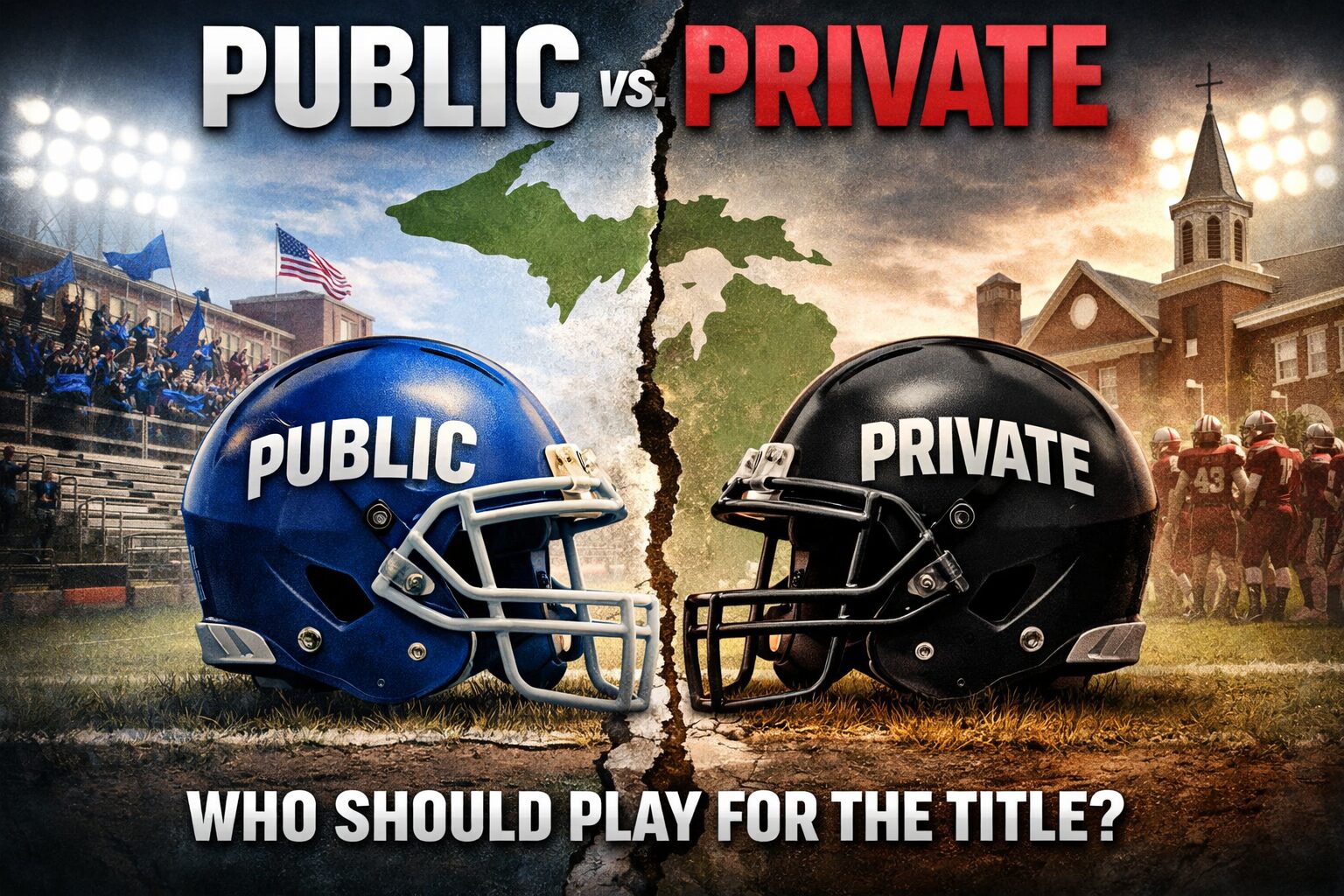
The stands are packed, the band is loud, and the town has circled this game since August. Your team wins it all — a championship run that becomes legend. But then the argument hits: Was the path fair?
That question has been debated in living rooms, locker rooms and message boards for decades. Now, Alabama has answered it in a dramatic way; voting to split public and private school football championships beginning in the 2026–27 season. While the decision happened in the Deep South, the ripple effects could stretch far beyond state lines, reaching places like Michigan, where the public vs. private debate has never fully cooled.
What Alabama Decided — And Why It Matters
In a 13–2 vote, the Alabama High School Athletic Association (AHSAA) approved a proposal that will separate public and private schools into different championship paths for football. Starting in the 2026–27 season, Alabama will crown six public school champions and two private school champions, rather than one unified playoff system.
The decision comes after years of discussion about competitive balance. Supporters argue that private schools often operate under different enrollment policies, attract students across district lines and, in some cases, sustain long-term athletic dominance that public schools struggle to match. AHSAA officials say the move is meant to address those concerns while still allowing public and private schools to compete against each other during the regular season.
Why Other States — Including Michigan — Are Paying Attention
Alabama isn’t alone in wrestling with this issue. States like Louisiana, Virginia, Texas, New York and New Jersey already use variations of split or modified playoff systems, including “select vs. non-select” divisions or competitive balance formulas.
Michigan, however, still operates under a unified postseason structure through the Michigan High School Athletic Association (MHSAA). Public and private schools compete together, with classifications based largely on enrollment and postseason success.
If Alabama’s model proves successful, it could reignite conversations in Michigan about whether the current system truly levels the playing field or whether a different approach is needed.
Potential impacts in Michigan could include:
- Renewed competitive balance debates, particularly in football and basketball, where private-school success often draws scrutiny.
- Pressure on the MHSAA to re-evaluate classifications, multipliers or postseason formats.
- Community and recruiting implications, as families and athletes consider how postseason opportunities may differ depending on school type.
The Case FOR Splitting Championships
Supporters of Alabama’s move believe the benefits are clear:
- Improved competitive equity: Separate championships could reduce mismatches and provide more schools with realistic title opportunities.
- Preserved rivalries: Regular-season matchups between public and private schools would remain intact.
- Clearer postseason paths: Schools would compete against others with similar structural realities, potentially enhancing playoff quality and parity.
To proponents, the split isn’t about exclusion, it’s about fairness.
The Case AGAINST the Split
Critics, however, warn of unintended consequences:
- Erosion of tradition: High school sports have long been about one true state champion. Multiple titles may dilute that meaning.
- Further division: Some fear this could lead to separate leagues or associations altogether.
- Logistical challenges: Scheduling, travel and playoff administration could become more complex and costly.
There’s also concern that separating championships sends the wrong message; that differences can’t be solved within a shared system.
What This Means for the Future of High School Football
Alabama’s decision may not immediately change policies elsewhere, but it undeniably shifts the national conversation. States like Michigan now have a real-world case study unfolding in front of them; one that could influence future votes, proposals and public opinion.
The bigger question remains: Is competitive balance better achieved by separation or by refining the system everyone shares?
Now We Ask You
This debate isn’t just for athletic directors and association boards.
🏈 What do you think?
- Should Michigan consider separating public and private school championships?
- Does this create fairness — or fracture tradition?
- Is there a better solution that keeps everyone under one banner?
If you are interested in more of our content, head to our website at catchmarksports.com, our YouTube, or our Facebook page!