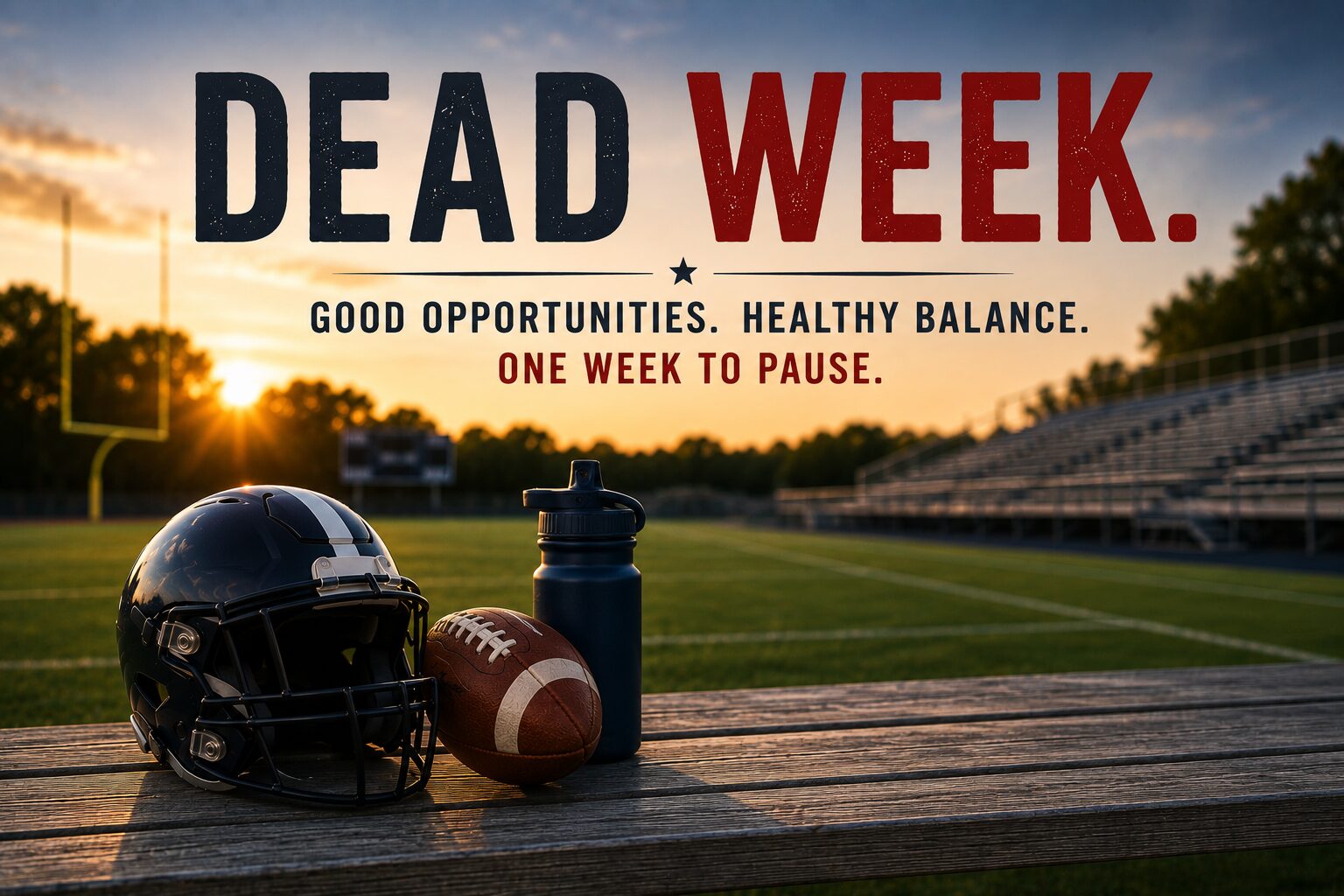
Every July, high school sports across Michigan come to a stop.
Weight rooms empty. Football conditioning pauses. Open gyms disappear. Coaches step away from their teams for seven consecutive days during what is known as Dead Week.
Most people see it as a welcome break in the middle of a busy summer.
And it is.
But Dead Week was not created simply because athletes needed a week off.
It was created because something much bigger had happened.
Somewhere along the way, healthy opportunities to improve slowly started turning into expectations.
What If Learning Worked the Same Way?
Imagine the last day of school.
Students head home excited for summer break, but before the first week is over, the emails begin arriving.
The math department offers weekly problem-solving sessions. English teachers schedule writing workshops. Science teachers organize Thursday labs. Music directors encourage additional rehearsals. History teachers host discussion groups throughout July.
Every opportunity is optional. Every activity is designed with good intentions. Every teacher simply wants students to learn and improve.
But then another school offers even more summer enrichment. A neighboring district adds another camp. Families begin wondering if taking a vacation means their child will fall behind. Students worry about missing opportunities their classmates are attending.
Eventually, schools are not just competing during the school year anymore. They are competing all summer.
At some point, it becomes such a concern that the state steps in and creates a mandatory “Dead Week for Learning,” one week where no school can offer academic camps, workshops, tutoring, or enrichment activities.
Most of us would probably think that sounds excessive.
We would ask ourselves, “How did we get to the point where schools needed a rule just so families could enjoy summer?”
That Is the Story Behind Dead Week
That scenario may sound far-fetched in academics, but it is remarkably similar to what happened in high school athletics.
Michigan’s Summer Dead Period was not created because football conditioning, basketball camps, volleyball tournaments, soccer showcases, or summer strength training were bad ideas.
In fact, each of those opportunities exists for the best possible reason: to help student-athletes improve.
The challenge was not any single camp, workout, or open gym.
The challenge was what happened when every school kept adding opportunities because every other school was doing the same.
Families found it harder to schedule vacations. Athletes worried about missing workouts. Coaches who wanted to give players time away wondered whether neighboring programs would continue training and gain an advantage.
No one intended to create that culture.
It simply evolved.
Recognizing that growing pressure, the Michigan High School Athletic Association established the Summer Dead Period in 2007. For one week, every member school pauses school-sponsored athletics. Not because improvement is bad, but because athletes, families, and coaches deserve the opportunity to step away without wondering if they are falling behind.
When Good Intentions Become Expectations
Perhaps that is what makes Dead Week so interesting.
Every summer opportunity was created with the right intentions.
Coaches were not trying to pressure families. Schools were not trying to make athletes choose sports over vacations. Programs were not trying to turn summer into another competitive season.
They simply wanted to give students every opportunity to grow.
But sometimes good intentions have unintended consequences.
When one school adds another camp, another school follows. Then another. Then another.
Before long, what started as an opportunity begins to feel like an expectation.
That is not unique to sports.
It can happen in music, theater, robotics, academics, and nearly any activity where people are constantly looking for ways to improve.
The real question is not whether opportunities are good.
Of course they are.
The question is how we prevent those opportunities from becoming something families feel they cannot say no to.
Even Dead Week Does Not Stop the Pressure Completely
Of course, Dead Week does not mean every athlete actually stops.
Many still train on their own. Some parents organize workouts. Some athletes work with private trainers. Others continue playing for travel teams, club programs, showcase teams, or outside organizations that are not directly connected to their school.
In some sports, the summer calendar barely slows down at all.
That is an important part of the conversation.
The MHSAA can pause school-sponsored athletics, but it cannot pause the broader culture around youth sports. It cannot stop the belief that more is always better. It cannot eliminate the fear that someone else is getting ahead. It cannot force every family to rest, reset, or step away.
That choice still belongs to parents and athletes.
And many choose to keep going.
Sometimes that choice is driven by passion. Some athletes genuinely love their sport and want to compete as much as possible. Some families enjoy the travel team experience. Some players are chasing college opportunities, greater exposure, or a higher level of competition.
There is nothing automatically wrong with that.
But it does raise an important question.
If the purpose of Dead Week is to create space, are we actually using that space?
Or have we simply moved the pressure from school teams to travel teams, private training, showcases, and outside competition?
That may be the modern challenge.
The rule creates the pause.
But families still have to decide whether to honor it.
More Than a Week Off
Dead Week is not really about taking seven days off.
It is about preserving something that can easily disappear when competition keeps growing.
Balance.
The balance between improvement and family. Between preparation and rest. Between creating opportunities and creating expectations.
Maybe that is the lesson behind Dead Week.
Not that athletes should practice less. Not that coaches should stop offering opportunities. Not that ambitious players should stop working toward their goals.
But sometimes the healthiest thing a competitive environment can do is intentionally pause.
And sometimes the healthiest thing a family can do is accept the pause instead of immediately filling it with something else.
What Do You Think?
Dead Week has been part of Michigan high school athletics for nearly two decades, but it still raises an important question.
When does a healthy opportunity become an unhealthy expectation?
If the MHSAA had never created the Summer Dead Period, would schools and teams have naturally protected time away, or would the pressure to keep up have continued to grow?
And even with Dead Week in place, are families truly stepping away, or has the pressure simply shifted to travel teams, private training, showcases, and outside competition?
We would love to hear from coaches, teachers, parents, athletes, and alumni.
Share your thoughts in the comments below.

If you are interested in more of our content, head to our website at catchmarksports.com, our YouTube, or our Facebook page! This coverage is powered by CatchMark Technologies: learn more at catchmarkit.com. Where you can find all of you MSP and Technology needs.