Legendary UCLA basketball coach John Wooden once said, “Basketball is a game of scoring, and the team that scores the most points usually wins.” The other night I popped on CatchMark SportsNet to see how local high school basketball teams were doing. As the scores rolled across the screen, I was genuinely shocked. Fans of the schools I am about to mention, please do not be offended. This is not a shot at any program. It is simply an observation that supports a broader trend.
Game after game was ending with teams struggling to reach even 40 points. Shelby finished with 31 against Manistee. Montague scored 38 against Whitehall. Oakridge ended with 30 against Ludington. And the list went on.
Some might respond by saying those teams are struggling this season. That may be true in certain cases. But the more telling detail is that the teams beating them are often not cracking 70 points either. Even wins are coming with modest offensive output.
That moment sent me down a familiar mental path. I played high school basketball in the mid 1990s, and I remember scores regularly being higher. Of course, time has a way of morphing reality, and nostalgia is not data. So I looked back.
In my junior year at Montague High School, during the 1993 to 1994 season, our team finished 10 and 10. We were not a dominant group by any measure. Yet we averaged 64.5 points per game, while our opponents averaged 65.6.
My senior year told a similar story. We finished the regular season at 5 and 15, clearly a rebuilding year by any standard. Even so, we averaged 62.95 points per game, while our opponents averaged 66.95. In fact, we failed to score more than 40 points only once all season. That came in the infamous slowdown showdown against Whitehall, a game in which we deliberately ran the “four to score” clock killing offence for the entire night in an effort to keep Whitehall’s prolific offense under control.
At a conference level, scoring was widespread. That same 1994 to 1995 season saw five players average 20 points per game or better. Kakaty averaged 31. Bays averaged 25. VanderSlice averaged 22. Lathrop averaged 21. Cutter averaged 20. The rest of the conference was not far behind.

Those numbers matter, not because the past was perfect, but because they confirm that higher scoring was not limited to elite teams or generational players. It was common across competitive, average, and even struggling programs.
So when modern scoreboards regularly show teams stuck in the 30s and low 40s, the question is worth asking. What changed?
This is not a talent issue. It is a basketball issue. And it starts with how the game is being taught, played, and valued.
Fewer Easy Points Means Scoring is a Grind
At the high school level, offense thrives on simplicity. Points most often come from layups, transition baskets, paint touches that force defensive rotation, and shots created through advantage basketball.
When those disappear, scoring drops quickly. Most high school teams do not have the elite shot making needed to replace lost layups and free throws with difficult perimeter attempts. Remove the easy points and every possession becomes a grind against a set defense.
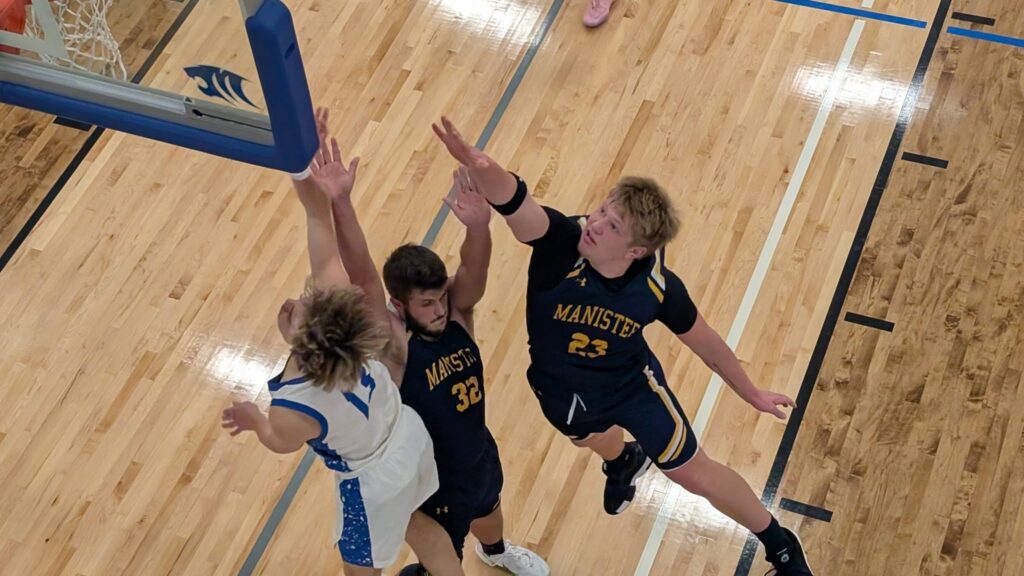
Positionless Is Not the Problem. Positionless With No Rules Is.
The promise of positionless basketball is appealing. Space the floor. Let players read the game. Encourage creativity. In theory, five out and motion offenses can be excellent teachers of spacing, cutting, and decision making.
In practice, many teams run a watered down version that turns into five players standing on the perimeter while one player dribbles. When that option is taken away, the offense freezes.
Coaches who teach motion correctly emphasize that freedom only works when paired with structure. Spacing and off ball movement must be understood and enforced. Development resources consistently identify spacing as one of the most misunderstood concepts among young players, particularly in environments where structure is minimized.
https://www.clrn.org/how-many-points-should-you-average-in-high-school-basketball/
When spacing and purpose are weak, positionless becomes purposeless. Defenses win by simply removing the first action.
The Culture Shift From Efficient Basketball to Individual Flash
What young players are rewarded for has changed. Social media highlights rarely feature the extra pass, the timely cut, or the early advance in transition. They feature isolation moves, broken ankles, and deep three point attempts.
Youth and high school coaches across the country have expressed concern that players are training for clips rather than possessions. The so called “bag” mentality promotes move collecting instead of problem solving. Players can execute a move but struggle to read help defense or create advantages for teammates.
The result is visible on game nights. Players look skilled but not effective. They can score in space but not within a system. They win moments but lose possessions.
The Three Point Copycat Effect and Why the Math Breaks Down
The three point shot is not the problem. Shot selection is.
High school basketball has increasingly mirrored NBA shot profiles without NBA spacing, shooting depth, or offensive rebounding. A Wharton School analysis of men’s high school basketball found that increasing three point attempt volume does not correlate strongly with winning or offensive efficiency.
https://mackinstitute.wharton.upenn.edu/wp-content/uploads/2017/06/2017-02.pdf
At the high school level, missed threes often lead to poor floor balance, limited offensive rebounding, and fewer transition opportunities the other way. What works at the professional level does not automatically translate downward.
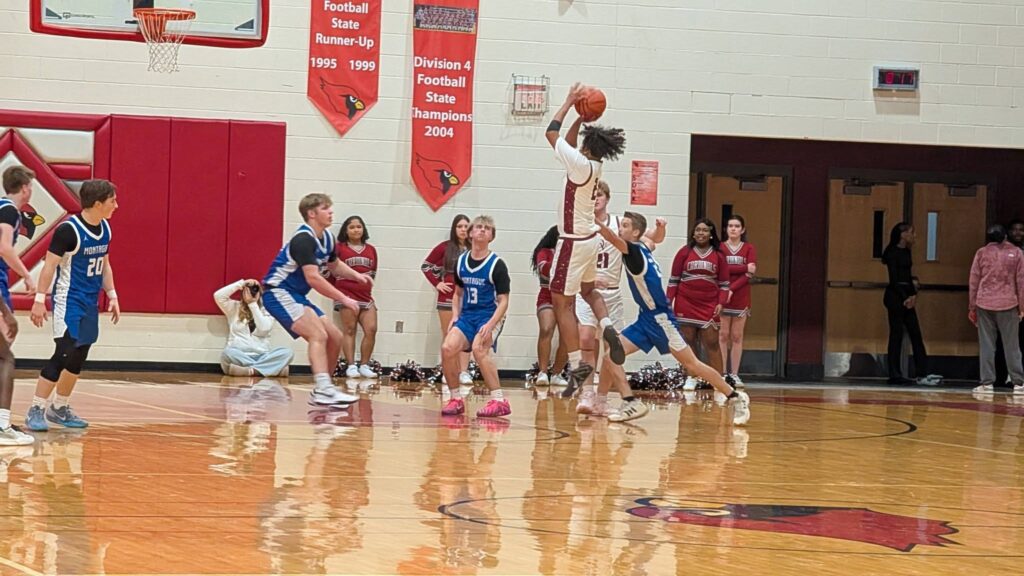
Transition Offense Is Fading, and That Is Where High School Teams Should Feast
If you want points without running half court offense, you run. Transition basketball produces the easiest shots available and places immediate stress on the defense.
Yet many teams struggle to generate consistent transition chances. Missed perimeter shots pull players away from rebounding position. Conditioning is often disconnected from pace. Players are taught moves more than early advantage decisions.
When transition is not emphasized, teams are forced into longer half court possessions against set defenses. Scoring suffers accordingly.
The Shot Clock Gap and Fewer Possessions
Another factor suppressing scoring is the absence of a shot clock in many states. While the National Federation of State High School Associations provides official shot clock guidelines, adoption remains inconsistent across the country.
https://www.nfhs.org/sports-resource-content/basketball-shot-clock-guidelines/
Without a shot clock, teams can legally stall possessions and drastically reduce pace. Fewer possessions almost always lead to fewer points, particularly in competitive or late game situations.
What High School Basketball Can Do About Scoring
The solution is not abandoning modern basketball principles. It is reclaiming their intent.
Positionless should mean versatile and intelligent, not unstructured and passive. Teams need clear rules within freedom. Paint touches should be expected. Off ball movement should be mandatory. Transition lanes and outlet decisions should be practiced daily.
Skill must be redefined. True skill is creating advantage, forcing help, and making the simple play that produces efficient offense.
Shot quality matters more than shot volume. Earned threes created through penetration and ball movement remain valuable. Uncontested layups and transition baskets remain priceless.
Closing Thought on Scoring
Scoring is not down because players are worse. It is down because too many teams are playing a version of modern basketball without the pieces that make modern basketball work.
Spacing discipline. Purposeful movement. Advantage creation. Transition pressure.
When positionless becomes purposeless, the game slows, efficiency collapses, and the scoreboard reflects it. If high school basketball wants the points back, it must bring the purpose back.
Check out all of our basketball related content here.